








6-6
2020
Command & Conquer: Remastered Collection has been released!
Posted by Banshee at Petrolution News on June 6, 2020
Command & Conquer: Remastered collection has been released yesterday. Here's the press release:
Command & Conquer™ and Command & Conquer™ Red Alert defined the RTS genre 25 years ago, and now they’re back and fully remastered in 4k by the former Westwood Studios team members at Petroglyph. The Command & Conquer™ Remastered Collection includes all three expansion packs, rebuilt multiplayer, a modernized UI, Map Editor, bonus gallery of unreleased FMV footage, modding support, and over seven hours of legendary remastered music by Frank Klepacki.
Check out the remastered experience in the official launch trailer below:
Both the Origin and Steam digital Standard Editions include the remastered versions of Tiberian Dawn and Red Alert, plus all three expansion packs (Covert Operations, Counterstrike, and The Aftermath), and tons of bonus features and improvements.
Head over to the PC Specs and Requirements page to find out what you'll need to start your campaign on the battlefield. And if you have any questions about how modding will work in the game, check out our FAQ or dive deeper with the Remaster Update and Open Source / Mod Support article here.
Welcome back, Commander.
It is worth mentioning that we have added support for both Conan Unconquered and Command & Conquer: Remastered Collection here at Petrolution. Also, the OS .BIG Editor tool has been updated to its latest version, with 64 bits support, being able to load and save .meg files, and correctly displaying the high resolution textures (32 bits TGA files) used in C&C: Remastered Collection. Enjoy the game and happy modding!
14-11
2019
Earthbreakers has been announced!
Posted by Banshee at Petrolution News on November 14, 2019
Petroglyph Games has recently announced a new game known as Earthbreakers. It is a spiritual successor to Renegade, so it is a First Person Shooter game that allows base construction using a team based resource system. Here's the trailer:
31-12
2018
Yuuzhan Vong at War Mod Spotlight
Posted by Digz at Petrolution News on December 31, 2018

The Yuuzhan Vong at War Mod got an honourable mention in this years Best Upcoming Mod of the Year Awards and did so in 2016 in a similar category, so what is all the fuss about?
The mod looks to bring a new era into the game, one talked about in Star Wars lore as being the greatest threat to the galaxy, we see Grand Admiral Thrawn mention it several times in the books and it brings genuine fear that a threat so large can come from the Unknown Regions that could destroy the entire galaxy. The mod is looking to be released as some point in 2019, with various stages of releases to accompany the different elements of the mod, it's a refreshing approach from the development team to release in stages and focus on the elements of getting those right whilst working on the larger incremental updates.
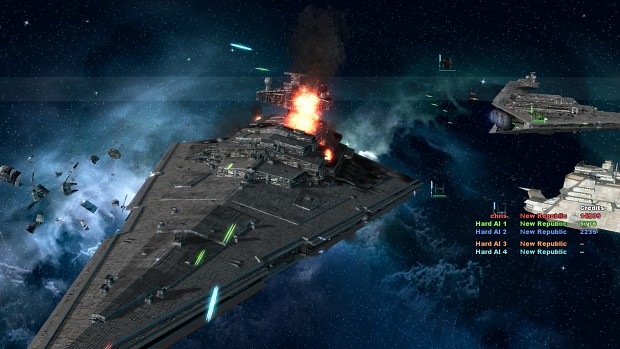
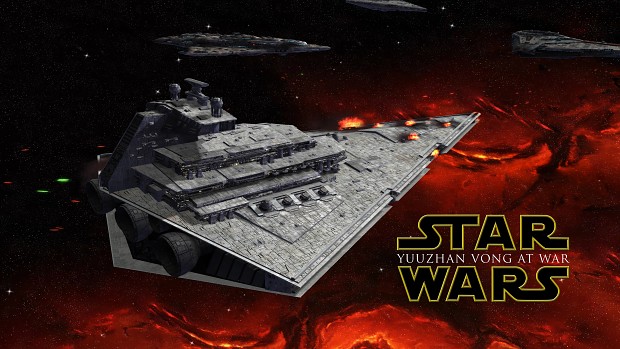
By focusing on just one of the game modes, "Aftermath" below is the description of the game mode which describes it better than I ever could, source can be found here:
The Aftermath mode is a unique and exiting experience. You are the commander of a crippled battle cruiser that was left behind after a fleet engagement. Your job is it to not only protect the beings under your command but go even further and get your ship back up and running. Resources are scarce and limited, and you’ll have to send out your transports to gather resources from debris fields and wrecked ships on the battlefield.
Once you started to scour the battlefield for scraps and debris, you will make a scary discovery: It’s not only your ship that was left behind. An hostile battle cruiser suffered a similar fate, and its commander is trying to repair the ship as well.
This is the moment you will enter into an arms race and whoever manages to repair the ship first will have the fire power to defeat the enemy once and for all.
The mod even has its own technology upgrade structure which it has aligned to the Yuuzhan Vong war which lasts five years, aligning it with that makes much more sense and each faction will upgrade differently according to their own characteristics by lore. More information on the technology upgrade can be found on their Mod DB page here.
The mod also features updates to the galaxy map and adds realism and authenticity to it, it also adds in a concept of "nav points" they allow for re-routing during the longer hyperspace routes. So with all these exciting changes to the gameplay mechanics, new factions too, and adhering to the lore that captures the imagination of most Star Wars fans it is no surprise why this mod was an honourable mention for best upcoming mod category.We expect great things here!
If you want to get the latest updates for the mod make sure you stay tuned here and also visit their website and their Mod DB page.
31-12
2018
Players Choice Mod of the Year Awards 2018
Posted by Digz at Petrolution News on December 31, 2018
The Players Choice Mod of the Year Awards hosted by MoD DB have been decided, over two weeks of voting and the top 10 have been announced! Gratefully the Empire at War games are well represented with two out of the top ten mods being from Empire at War: Forces of Corruption! Those two mods are Awakening of the Rebellion and Thrawns Revenge: Imperial Civil War.
The two mods have a great following and we are as a community so proud of what these two mods, as well as all other mods for the game, have performed in these awards and I'd like to congratulate the two teams from Awakening of the Rebellion and Thrawns Revenge on behalf of the community here and at Revora for their dedication, hard work, and sheer brilliance for creating such mods that we enjoy playing so much.
If you haven't heard of these fantastic mods I'll put a brief summary taken from their Mod DB pages with the relevant links and a helpful gameplay video to let you see the brilliance they have created.
Awakening of the Rebellion 2.7 is the upcoming Version and its a massive Update and Improvement then the actual release Version 2.6. The AI is almost rewritten and will be a challenge as ever before There are new Story Events and reworked existing ones. All Space and Ground-Units are updated and/or replaced with new Models/Textures. New Soundeffects and Music-Tracks, a New Galaxy Map that is almost Canon and new Space and Groundmaps.
Thrawns Revenge: Imperial Civil War
Thrawn's Revenge: Imperial Civil War is a total conversion mod for Forces of Corruption which brings the game into the Post-Endor period. The mod features a new era-based story progression system covering the timeline betwen the Battle of Endor and up until the start of the Yuuzhan Vong War. The mod includes hundreds of new planets accross almost 20 Galactic Conquest scenarios, hundreds of units and heroes, new particle and other graphic effects, and several new gameplay mechanics.
28-12
2018
EaW Remake Mod - Review
Posted by Digz at Petrolution News on December 28, 2018
I'm sure everyone has heard about Petroglyph re-mastering Command and Conquer and Blizzard working on remastering Warcraft 3, I'm sure a lot of people are wondering whether Petroglyph will ever remaster Empire at War - no need Petrgolyph, The Empire at War remake team have us covered!
The mod has overhauled the graphics of the game and has produced such quality and depth in design it really feels like a re-mastery, maybe if Jeroenimo, the creator of the mod reads this he may change the title to Empire at War Re-mastered! Before I go any further, I truly believe a picture, or in this case a video paints a thousand words so I'll just let you watch a video on Jeroenimos YouTube channel that was released a few days ago that shows off the new control ship and battleship skins:
The level of detail in the skins is completely out of this world and when playing the game it really gives you the feel of a modern day game and when you take down a ship you smile from ear to ear, just turn up the volume and play to your hearts content!
The mod also makes a big statement in trying to turn the world into an ever changing environment, we have seen big developers try and fail at this, we have seen others succeed. To quote the development team "The idea is to give the galaxy a more varied and alive ecosystem where you can build different units on different planets." This is a fantastic idea and to an extent EaW vanilla already has this concept but nowhere near the scale that this mod brings, you certainly do not want your enemy to be making those all powerful interdictor ships, this means expanding your empire in the campaign map and in the correct way is crucial. The level of thought required in your campaign has just increased tenfold and this, as gamers, is what we want. We want to be challenged, we want a living world that constantly changes and it brings into perspective the way we plan ahead in our campaigns. Different planets also have increased values in regards to your economy, so for example you want to go for Bespin alongside other climate planets that will give you income boosts according to its climate.
The gameplay itself is smooth, aggressive, and visually appealing with an expanded roster of ships. Many people will think just putting lots of ships in a game does not make it awesome, you're quite right but ensuring the factions are balanced with a large roster of ships does it make it awesome and this mod certainly does that. If you're undecided my advice would be to give the mod a go and I promise you won't turn back. A forewarning the mod is still in development stages, it has not been fully released yet so there is still some work to do and I think a top priority is to increase the stability of the game as it does crash from time to time, that is essentially the single drawback so far. It is on the Steam Workshop or you can find it on ModDB here. The Mod won an honourable mention in this years ModDB Mod of the Year Awards in the Players Choice Awards category, I'm a little sad it did not get into the top 10 but I'm sure next year upon even more work and exposure in the community it will. I've been watching Jeroenimos YouTube channel lately, particularly the tutorial videos on the mod which is essentially him doing a walkthrough playing the Empire campaign, there must be about 10 hours worth of footage in this walkthrough split into different videos so please give them a watch and by the end of the first walkthrough which is below I know you'll be hitting that download button.
Petrolutions official rating review of this mod is an 8/10
26-12
2018
Petroglyph Announce Conan Unconquered!
Posted by Digz at Petrolution News on December 26, 2018
The title says it all and the trailer certainly wets the appetite! Alongside Command and Conquer re-mastered Petroglyph are working on another title due to be released in the summer of 2019 called Conan Unconquered.
Conan Unconquered is a strategy game set in the barbaric world of Conan the Barbarian where you must build your stronghold and assemble an unconquerable army to survive the savage hordes of Hyboria. Wave after wave of increasingly more difficult enemies will rush at your gates and you will need to manage resources, research new technologies to advance your defenses, and recruit an ever-growing army if you are to save survive utter destruction.You can choose to play the game entirely alone in single-player, but Conan Unconquered can also be enjoyed in full two-player co-op allowing for a truly unique, shared multiplayer experience. Players share a base, but both can freely construct new buildings and amass an army to reach their common goal.Similar to games such as They Are Billions, the enemy hordes will keep coming at you and how long you can resist the invasion depends entirely on your ability to build your stronghold and lead your army. Gameplay is real-time, but you can also pause at any time to issue commands and start construction of new buildings. Battles will be bloody and savage with players having to deal with anything from fires raging through their stronghold to piles of corpses spreading death and disease.The savage horde is at your gates. Will you fall or will you remain unconquered?
The game as the quote above from the Steam page states it is going to be a defence game built upon your stronghold and armies that you build, it will have lots of re-playability with the maps being randomly regenerated and you can play this offline solo or online as a co-op game.
The steam page can be found here where you can find more information about the game.
14-11
2018
Tiberian Dawn and Red Alert 1 being remastered by Petroglyph!
Posted by Banshee at Petrolution News on November 14, 2018
Some of you guys might think that this announcement belongs to our friends over CnC Guild than here, but we are truly thrilled to confirm that Command & Conquer Tiberian Dawn and Red Alert 1 are being remastered at Petroglyph Studios and being published by EA. Frank Klepacki will be doing the music, of course. The announcement comes from the official source and we'll quote it below:
Fellow Command & Conquer fans,
A month ago, we let the Command & Conquer™ community know we were bringing the franchise back to the PC, starting with a remaster initiative. The reaction from fans has been amazing, with many of you sharing your favorite C&C moments from the past 23 years. We have been reading these comments and listening intently. And now, we are ready to reveal our first PC offering and how your suggestions are already influencing our approach.
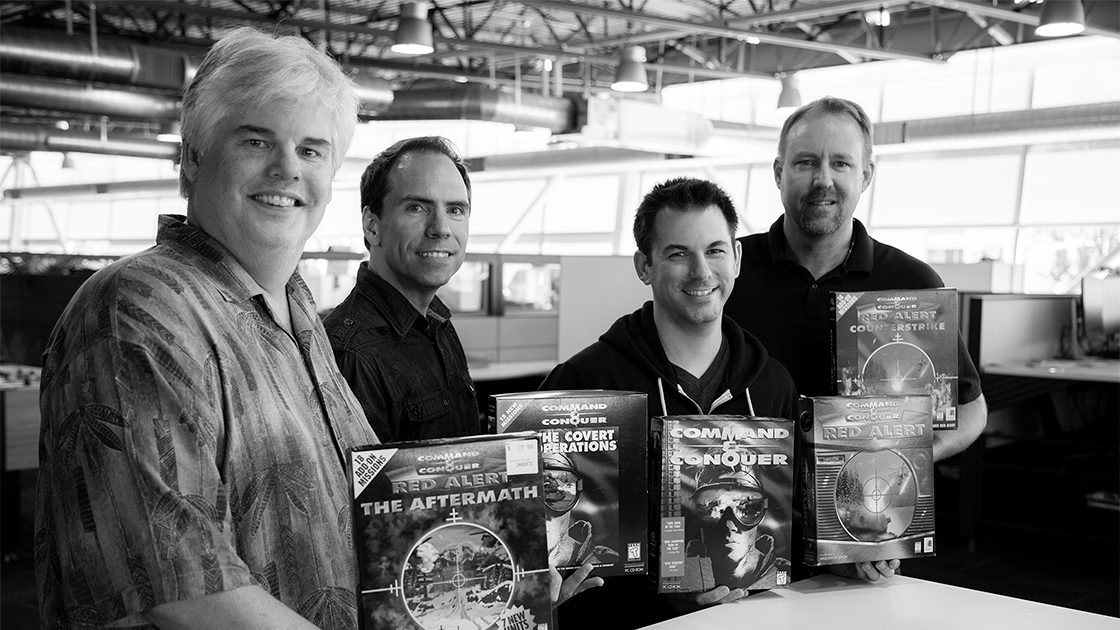
Today, I’m thrilled to tell you we are going back to the beginning. We have decided to remaster Command & Conquer: Tiberian Dawn. And while this is incredibly exciting on its own, we’re also aware of how passionate the community is about the Red Alert universe. So, we will also remaster the original Command & Conquer: Red Alert™. But what about the classic expansion packs you may ask - Covert Ops, Counterstrike, and Aftermath? Well, C&C and Red Alert wouldn’t be the same without them, so all three expansion packs will be bundled with the base games into one remastered collection - without microtransactions.
In addition to the excitement and support of this remaster initiative over the past month, there has also been a healthy skepticism that we can pull this off. How are we possibly going to remaster these titles while maintaining the authenticity of the original experiences? Bottom line, there is no better way to achieve this than to partner with some of the talented developers who brought these original games to life.
So, after years of the fans asking for their involvement, I am humbled to announce that EA is going to partner with Petroglyph Games to develop the C&C remastered collection.
Petroglyph Games includes many of the original developers from Westwood Studios, and some of the most influential members of the original Command & Conquer development team from 1995. Joe Bostic is known as the co-creator of C&C, having also served as the Lead Programmer on Tiberian Dawn and Red Alert. Steve Tall joined Joe as a Lead Programmer on Red Alert, and Mike Legg contributed to all forms of audio systems at Westwood, having been an employee since 1986! All three members helped start Petroglyph Games in 2003 after the closure of Westwood and are joined by a veteran group of RTS developers from the past 15+ years. And don’t think we haven’t noticed the #1 request from the community in all the comments from the past month... You want Frank Klepacki. So as a cherry on top for the fans, we are thrilled to announce that Frank will be re-joining Petroglyph Games to be our Composer and Audio Director for the remaster collection!
On a personal note, I can tell you the past few weeks have been surreal. During my first visit to Petroglyph, I was able to brainstorm “C&C feel” with Joe, sit with Frank and hear him recite Commando lines, and gab with Steve about whether we should fix the Tib Dawn Harvester AI. Getting to chat C&C with the original developers has been one of the highlights of my gamer journey, and I can’t wait for all the incredible conversations to come.
In addition to the fantastic team at Petroglyph, we will also be partnering with Lemon Sky Studios to help bring these original games to 4k glory. Lemon Sky is one of the premier art studios around the world, with a unique specialty in remastering classic RTS titles. After meeting their team and hearing their passion for C&C, we are incredibly lucky to have them team up with Petroglyph to develop the highest quality C&C possible.
The exciting part is that we haven’t started development yet. The community is literally getting in on the ground floor of this project and have every opportunity to help influence how we build this remastered experience. Please continue to engage on Reddit and community channels and help us create the best possible remasters of C&C and Red Alert!
Welcome Back, Commander!
Jim Vessella
Jimtern
Post your comments here and hint your C&C friends  .
.
8-4
2018
Phoenix Rising v2.0 Public Beta
Posted by evilbobthebob at Phoenix Rising News on April 8, 2018
After the success of the demo, I have decided to move forward with a public beta phase, released via update to the Steam version of the demo. This will introduce the full set of galactic conquests that are currently work-in-progress. You should expect more bugs than the demo version, but also many more opportunities to try out new parts of the mod.
Known issues:
Missing text
Poor performance in some GCs
Missing CSA units
Unit filter buttons may sometimes display an incorrect state if pressed rapidly
Sandbox missions may show incorrect information
Changelog from demo:
Full GC set (Work in progress)
New filter buttons: click to hide different classes of space units/research
Updated tech trees for Rebels and Empire
Fixed some weapons not firing from muzzles correctly
Space colonies now correctly show up in battle results
Please report bugs here or on the Steam discussion page.
25-2
2018
More Demo bugfixes
Posted by evilbobthebob at Phoenix Rising News on February 25, 2018
A new set of bugfixes and other improvements has made its way to the demo, both on Steam and ModDB.
Changelog for version 2.0.2
- Did a pass on ground unit AI combat power so the AI sends more reasonable amounts of units into land combat
- Added infantry highlight icons so that infantry are more visible in combat. Current icons are Red for Imperial infantry, Blue for Rebel infantry and White for Independent infantry.
- Fixed firing muzzle positions for AT-AT, T4 series, and ground-based turbolaser turrets.
- Improved AI starbase upgrade responsiveness, they should now tend to upgrade if the opponent does.
- Garrison structures are now visible through fog-of-war
- Kyle Katarn now uses a Stormtrooper One blaster rifle instead of the post-Dark Trooper campaign assault cannon.
- Golans and shipyards are now placed better on space maps. Golans should generally protect shipyards and the colony.
- Land combat camera now has full yaw rotation and adjusted zoom
- Added Skyhook fleet information in the startup dialogue box.
- Added TIE Starfighter specific skin (the TIE Starfighter is the first in the main TIE line)
- AI responds better to planetary bonuses.
- General scripting performance improvements
- Multiple attempts at reducing the prevalance of save game crashes.
- Updated space missile models for concussion, proton torpedo and proton rockets
5-2
2018
Demo bugfixes
Posted by evilbobthebob at Phoenix Rising News on February 5, 2018
- Improvements: Improved skirmish AI, buffed AA build pad turrets (now have double fire rate), added time-scaled particles for status effects. Made easy difficulty slightly easier.
- Improvements: Added units back into skirmish mode. Further skirmish AI tweaks.
- Bug fixes: Overracer bike icons; Text fixes for Rebel structures; attempted fix for crashes on Mustafar/Clakdor; attempted fix for save game crashes.
- Bug fixes: Fixed crash on Mustafar and Clak'dor maps. Removed debug info. Fixed reinforcement problems in skirmish (side effect: skirmish Golans and GC space colonies now prevent reinforcements in a radius around them)
- Bug fixes: Fixed squadron ability autofire scripts. Fixed CSA starbase upgrade cost in skirmish. Fixed text errors with Xg Star Wing and made Dominator III SD buildable once researched. Attempted to reduce the issue where fighter/bomber/transport units fly all over the map. Attempted to further improve savegame bugs.
- Bugfix: reduced planet texture resolution to improve performance, reduce chance of savegame crashes, and because the game can't render 4k textures.
- Fix for Tarkin respawn
- Fix for Clak'Dor VII crash
13-1
2018
Phoenix Rising v2.0 Demo
Posted by evilbobthebob at Phoenix Rising News on January 13, 2018
After 5 years, we finally have v2.0 of Phoenix Rising ready to demo, with the Operation Skyhook Campaign.
Download here for a manual installation: http://www.moddb.com...rising-v20-demo
Or find us on the Steam Workshop at: http://steamcommunit.../?id=1235783994
Experience the lead-up to A New Hope from both sides of the Galactic Civil War, as told in the Legends universe
Selection of missions provide guidance in the early stages of the campaign. The later stages are up to you!
Command the Rebel Alliance from hidden fighter bases, striking against Imperial convoys and trying to discover the location of the Death Star construction site
Lead the Galactic Empire to victory, protecting the Death Star and crushing the Rebellion across the galaxy
The Galactic Empire is recommended for first time players of Phoenix Rising.
Short summary of changes:
- Sweeping optimization improvements, including a "light" campaign for those having performance problems.
- Rewritten galactic conquests (Demo featured: Operation Skyhook)
- Rewritten AI to be more intelligent and challenging
- All hyperspace travel now done via hyperlanes, with bonus speed and income from different sizes of route
- Complete overhaul of planet locations, bonuses, and abilities
- Over 50 new ground maps for v2.0, many new space maps
- Both land and space skirmish are available (though land skirmish is still unfinished for the CSA)
- Space skirmish has been completely rebalanced to be more of a competitive experience
- New armor/shield/damage system for space combat, bringing it in line with our ground combat changes from v1.2. New space units and ground vehicle
- Improved weather system and atmospheric effect
- New hero system
4-1
2018
Forged Battalion Gameplay
Posted by Banshee at Petrolution News on January 4, 2018
For those wondering how will the next Petroglyph's RTS, Forged Battalion, looks like? Here's a 20+ minutes video featuring its gameplay, by Smash GaminG!:
Share your comments here. What do you think? Are you interested on joining its early access on Steam on january 16th?
Thanks Houseplant for the news tip.
18-12
2017
v2.0 Changelog
Posted by evilbobthebob at Phoenix Rising News on December 18, 2017
Below is a summary of changes to v2.0, as well as notes regarding what will be included in the demo version, coming soonTM
General

- Rewritten AI to be more intelligent and challenging
- AI now has some factional differences in style
- AI will correctly build units and structures based on its planetary bonuses
- Improved AI in tactical mode
- Rebalanced tech trees
- Functional CSA faction (full release only)
- Sweeping optimization improvements
- Addition of “light” campaign options for those who prefer high performance
- Many quality-of-life improvements
- Tooltips for all units contain all the statistic information you need
- Improved advisor hints to introduce you to the mod’s features
- Building and shipyard tooltips tell you what they can produce
- Improved research display
- Difficulty levels:
- Easy: AI gets 10% fewer credits and takes 10% longer to build units
- Normal: AI is exactly on par with the player
- Hard: AI gets 10% more credits, takes 10% less time to build units, and units have 20% more damage, 20% more health, and 25% more shields.
Galactic Mode

- Rewritten galactic conquests (Demo featured: Operation Skyhook)
- All hyperspace travel now done via hyperlanes, with bonus speed and income from different sizes of route
- Starships now cost population proportional to their crew requirements
- Complete overhaul of planet locations, bonuses, and abilities
- Planets now provide population carefully calculated from their statistics
- Bonuses are rebalanced and clarified with improved tooltips
- Planet info screens notify you of environmental or population conditions that affect production
- Many new planets added
- Overhaul of planet icons and base level display
- New planet textures
- Over 50 new ground maps for v2.0, many new space maps
- Restoration of classic EAW sandbox missions (full release only, not demo)
- Rebalanced freighters
Skirmish Mode

- Both land and space skirmish are available (though land skirmish is still unfinished for the CSA)
- Space skirmish has been completely rebalanced to be more of a competitive experience
- Units build faster and are cheaper
- Income scales better with station level
- Unit costs and build times balanced per unit and per unit class
- AI greatly improved compared to v1.2
Space Combat

- New armor/shield/damage system for space combat, bringing it in line with our ground combat changes from v1.2.
- Damage is now applied after armor subtraction e.g. laser damage 16 vs armor 12 does only 4 damage to a starship hull.
- Torpedoes and some other weapons can pierce armor.
- This means that light craft can barely damage capital ships. All weapons do a minimum of 0.5 damage if armor is equal to or greater than weapon damage.
- Shields absorb a percentage of damage from incoming fire based on unit class
- New space units (* = buildable in demo): Lictor-class Dungeon Ship, Providence-class Destroyer*, Belbullab-22 starfighter, Defender Starfighter*, TIE Vanguard, Diamond-class courier ship, Manka-class war Frigate*, G-1A Starfighter, Sheathipede-class Transport Shuttle, Y-85 Titan Dropship*, YV-100 Light Freighter, YV-330 Light Freighter, YV-929 Armed Freighter
- Rebalanced starship and starfighter weapons for the new combat system, rewriting thousands of hardpoints
- Space Colonies are now armed with turbolasers at all levels, and provide minor fire support to defending fleets
Ground Combat

- New ground combat bunker system, with many civilian structures available to hide your infantry
- New ground vehicles (* = buildable in demo): AAT, HMP gunship, MTT, OG-9, S-1 Firehawke*, V-Wing Airspeeder*
- Improved weather system and atmospheric effects- don’t let infantry get stranded on planets with a Type IV atmosphere!
- Infantry carry appropriately-modeled weapons in most cases
- New ground structures: Bank, Listening Outpost
Heroes
- New hero system with consistent hero ratings and upgrade paths
- Space heroes now require a flagship to attach to in many cases
- New heroes (* = playable in demo release): 4-LOM, Adar Tallon, Andoorni Hui, Apailana, Appo, Barrow Oicunn, Bevven*, Blitzer Harrsk, Bror Jace, Clyngunn, Cody, Comeg, Corran Horn, Crueya Vandron, Devlia, Erisi Dlarit, Evir Derricote, Gavin Darklighter, Ghorin, Haashn, Havet Storm, Hurst Romodi*, Kirtan Loor, Kosh Teradoc, Laryn Krefey, Lujayne Forge, Male Dee, Mawsh’iye, Meena Tills, Morteos, Nawara Ven, Odd Ball, Onara Kuat, Ooryl Qrygg, Osted Wermis, Peshk Vrisyk, Ragab, Rhysati Ynr, Riv Shiel, Rojahn, Sander Delvardus, Shaak Ti, Shea Hublin, Talon Karrde, Tensiger*, Terrinald Screed, Thaneespi, Theol Drost*, Treuten Teradoc, Tundra Dowmeia, Uwlla Iillor, Verrack, Zel Johans*, Zsinj, Zuckuss
Operation Skyhook- Demo Release GC
- Experience the lead-up to A New Hope from both sides of the Galactic Civil War, as told in the Legends universe
- Selection of missions provide guidance in the early stages of the campaign. The later stages are up to you!
- Command the Rebel Alliance from hidden fighter bases, striking against Imperial convoys and trying to discover the location of the Death Star construction site
- Lead the Galactic Empire to victory, protecting the Death Star and crushing the Rebellion across the galaxy
- The Galactic Empire is recommended for first time players of Phoenix Rising.
8-12
2017
v2.0 Demo Coming Soon(tm)
Posted by evilbobthebob at Phoenix Rising News on December 8, 2017
As you may or may not be aware, I am still working reasonably regularly on the mod and have got it to a stage where I feel comfortable releasing a focused demo version of Phoenix Rising 2.0. Currently, the version is in testing, but you can get a sneak-peek from Corey, lead developer on the Thrawn's Revenge series of mods, who has graciously begun a series of videos of the demo test build on his Youtube channel. The first video is here
2.0 will include all the changes noted in previous news posts, but there will be a summary of changes around the release time.
There is no concrete release date for the demo build, so stay tuned.
17-10
2017
Forged Battalion has been announced
Posted by Banshee at Petrolution News on October 17, 2017
Petroglyph Studios has announced a new RTS game for Steam known as Forged Battalion. Here's the trailer:
In this game, you're part of a resistance group, taking the world back from a military force called The Collective at the end of the 21st century.
It should come with the following features:
- Strong focus on unit customisation and building your own faction. You can alter every unit's chassis with different weapons, locomotor types and regenerative armor.
- There will be a 'persistent tech tree', meaning that each battle will contribute to your overall progress, helping to unlock new blueprints.
- There'll also be co-op and competitive multiplayer for up to eight players, also something that is being called a 'dynamic story campaign' and Steam Workshop support.
- Expect superweapons.
- The first early access version should include at least five campaign missions, different multiplayer modes and five multiplayer maps.
Forged Battalion will launch in 2018 on Steam Early Access. Thanks to Plokite_Wolf for the news tip.
10-9
2017
Installing mods for Empire at War Gold Pack - Another method
Posted by Digz at Petrolution News on September 10, 2017
I released a video many years ago on how to install mods via Steam for Empire at War and Forces of Corruption. With the release of the new patch bringing back multiplayer and whatnot I thought I'd give the game another go and try out some mods too!
I could not install them for the life of me from the steam workshop (game just kept crashing), by my old option or in the game via the "mods" option where people said it'd close the game then restart with the mod. So I went for a final push and created shortcuts instead and used the information you would put into the launch options on Steam but into the "target" box of your shortcut file of the main .exe for the game.
Watch the video below, this was the final straw before I just played online and a few campaigns and let the game rest. Fortunately it worked for me and I can enjoy some of the great mods the community has made!
4-9
2017
New Patch for Star Wars: Empire at War (Steam)
Posted by Banshee at Petrolution News on September 4, 2017
It seems that Disney has recently made some kind of deal that made Petroglyph add some interesting updates to the Steam version of the game. Here's their developer note about this subject:
A note from the developer.
Hi Everyone,
We have continued to watch the EAW community closely over the years and appreciate all the excellent support you have given us and the game. Thanks to all of you for the great feedback, awesome mod packs, and overwhelmingly positive reviews.
Check out the full press release here.
Here is a list of improvements made to the game.
· Steam multiplayer support in both FOC and EAW
· Enabled selection/list of player mods on hard drive, including mods via Steamworks
· Enabled windowed mode support
· Additional bug fixes and optimizations
We hope you enjoy this special update.
- Petroglyph
In a small note: the original multiplayer worked with GameSpy, which is gone for a very long time already.
3-9
2017
We're on the workshop!
Posted by evilbobthebob at Phoenix Rising News on September 3, 2017
Hey guys
With the update(!) to Empire at War on Steam, turning multiplayer back on, fixing some bugs, and adding Steam workshop support, I worked all day yesterday getting Phoenix Rising onto the workshop. It's available for download here: http://steamcommunit...873&searchtext=
Please post in this thread if you have any troubles installing/running the workshop version, as I haven't had much chance to test it myself.
30-8
2017
8-Bits Armies for Nintendo Switch
Posted by Banshee at Petrolution News on August 30, 2017
If you are a happy owner of Nintendo Switch, you'll be happy with this news: 8-Bit Armies is being ported to your video game soon. At least, according to this "Nindies" trailer.
29-7
2017
Battle Blitz has been released.
Posted by Banshee at Petrolution News on July 29, 2017
Hello everyone. Today, while browsing the web, I've found out about something Petroglyph has just released. For modding, it is useless. But if you have a Gear VR, it might be fun if you have 5 dollars to spare. It is called Battle Blitz.
There isn't much material to share about this game yet and probably there won't be. Here's how the site I've linked above describes the project:
Embark on a fun and challenging "lite" Real-Time Strategy campaign against an AI bent on your destruction! Construct your base, build your army, and determine your strategy of attack. Every map provides a unique challenge with new units, obstacles, and traps to contend with. You can even advance your technology to build the fearsome nuclear silo and rain molten destruction on your enemy! As you level up your character, you’ll earn rewards for technology advancements that can be placed into your own custom maps to share with other players. Other features include Touch controller support, an in-game tutorial, leaderboards, map editor, and the classic base-building, economy management, and strategic battles that strategy players love to dig into.
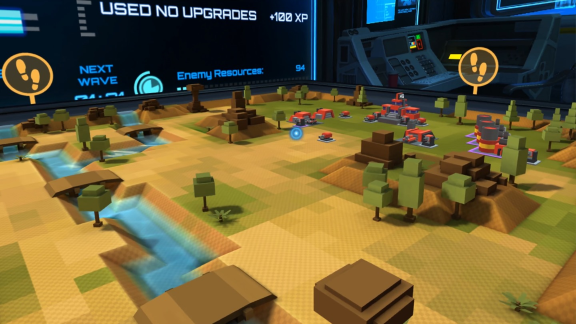
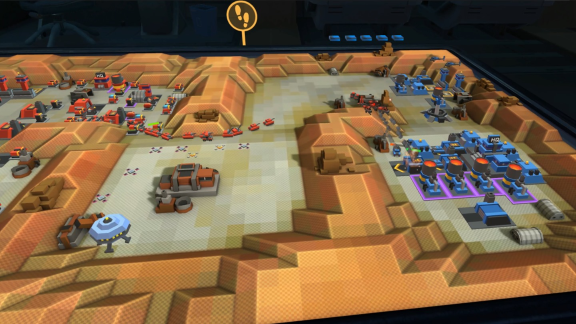
It seems that any similarity with 8-Bits Armies is not a mere coincidence. If you are interested in the game, click in any of the pictures and have fun. Thanks to Plokite_Wolf for the tip.